

What We Once Were
The War on Christian Men: Part IV

This is the fourth installment of a series of 5 articles titled The War on Christian Men: A systematic examination of how modern culture attacks masculinity.
I recommend you read the first installment here, and then continue with the rest.
We’ve spent a couple of weeks examining how modern culture psychologically castrates Christian men, but now it’s time to discuss the antidote to the great emasculation campaign which has left nearly all modern men apathetic and fearful.
Men are slowly waking up, but sadly, most will look towards the gurus of the world to try and find some guidance. However it’s not in them that we’ll find those ultimate examples of virtue that we can strive to imitate. It’s in 2,000 years of Catholic masculine saints who combined spiritual depth with decisive action, proving authentic masculinity reaches its highest expression in Catholic virtue.
Jesus Christ: The Ultimate Masculine Model
As Christian men, we can never lose sight of Who it is we follow: Jesus Christ, the only perfect man, He who is God Himself.
Any efforts that we undertake to fight back against the emasculation propaganda and build ourselves into real, masculine, virtuous men will be futile if we forget that the goal we’re aiming towards is to perfectly imitate Christ in our words, thoughts, and deeds. For us to even start aiming at that goal, we need to get to know Jesus. Not the soft, watered down version of Jesus proposed by those who seek to dilute Truth and make it comfortable and unchallenging, but the Christ of the Gospels, the historical Jesus, the real Jesus, who was not only loving and forgiving, but also righteous, courageous and just.
We all know Jesus is forgiving, and we all know He’s charitable. We’ve been very much in contact with the tenderness of His Heart. That side of Him has never been forgotten. But it has failed to be contrasted with the other, just as real side of Him: His righteous anger, clear authority, physical courage and faithful commitment to Truth.
Christ shows us His righteous anger when he made whips, and overturned the tables of those who were using the Temple as a place of business (John 2:13-16)
He shows us how committed He was to Truth when He called the Pharisees and rebuked them strongly for being hypocrites and for the wickedness of their hearts. (Matthew 23)
Christ shows us His clear, undeniable authority all the times He said: “You have heard it said... but I say" (Matthew 5)
He showed us His incredible physical courage when He walked into Jerusalem knowing death awaited. (Luke 9:51)
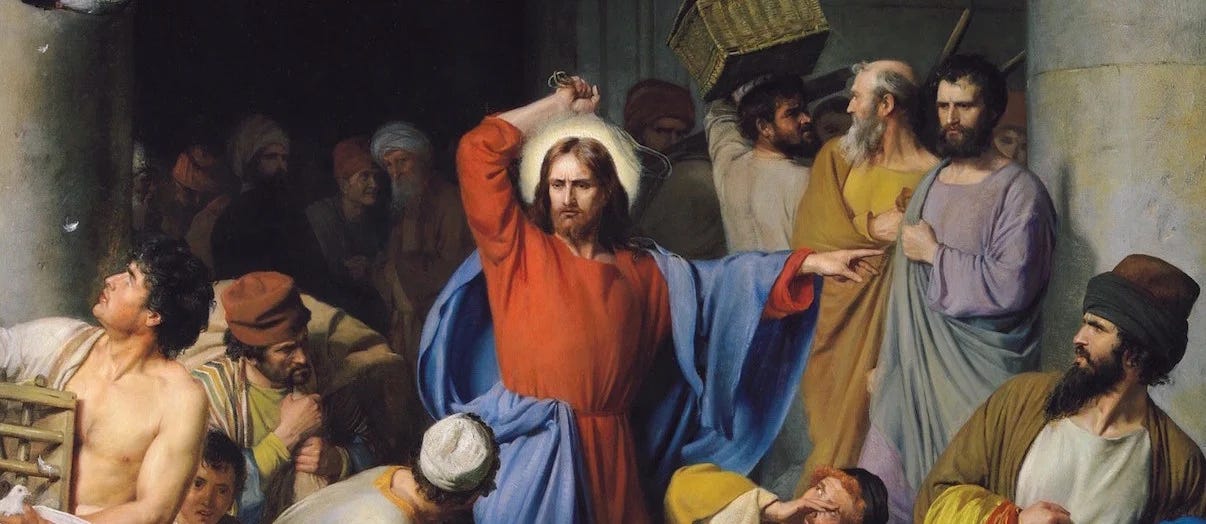
A large portion of the misunderstandings about masculinity within the Church today stem from a widespread failure to familiarize oneself with the true figure of Jesus Christ, who perfectly balanced tenderness and charity with justice and courage.
Beyond the obvious virtues showed during His ministry, think for a second about the main lesson that the life of Christ teaches us. What’s the main reason for His coming to earth? What’s the culmination of His work here on earth?
The ultimate sacrifice. Nothing less than tragic, terrible, painful death. Crucifixion. Facing death willingly and without ever shying away from His offering Himself to bring us undeserved salvation.
His offering establishes the pattern for masculine sacrifice, and it is His willingness to die for those He loved what serves as the foundation of true, genuine masculinity. Do you see now why the model of Christian masculinity differs from the flawed models of masculinity that the gurus of this world present?
Christian masculinity requires self-denial and the willing carrying of burdens (not just our own but those of the people we love). Red-pill masculinity is all about self-glorification, pride, and pleasure, the complete opposite of the self-giving and sacrificial masculinity that Our Lord and Savior exemplifies.
The Cross is the ultimate show of fortitude: Christ took all our sins and all our guilt upon Himself, choosing to die to bring us to life. That’s what we are called to model: a willingness to lose our own lives for the sake of those we love, a kind of strength that is uncommon even amongst those who profess themselves “masculine”.
Ancient Traditions of Manliness
Warriors of Old
Beyond the perfect example that is Christ, there’s plenty of other men throughout Christian history who exemplify the fighting spirit and the commitment to virtue that our age is so deprived of.
The entire Christian faith rests on the shoulders of men who were truly masculine, courageous, faithful, and willing to answer God’s call to action. Jesus first and foremost, yes, but who can deny all the other men whose lives serve to educate us in the virtues of manliness?
Scripture is full of examples of courageous men who the modern man would be wise to learn from:
King David, a young shepherd facing a seemingly unbeatable giant, armed with nothing but a sling, some stones, and an admirable dose of faith in God almighty.
Moses, confronting Pharaoh time and time again, risking his life each time, willing to be the spokesman of his suffering people. Moses, again, leading hundreds of thousands through the wilderness, carrying the torch as a prophet of The Lord, facing war, hunger, thirst, and the disbelief of the people he strived so hard to lead to freedom.
Joshua conquering Canaan and leading his people decisively against great odds, resting firmly in the knowledge of God’s power.


These are not mere stories, these are true historical events of real, flesh and blood men. Stop for a second and consider that these are your spiritual ancestors, and think about yourself in comparison to them.
We need to let the full weight of our inadequacy weigh on our shoulders, not so we can cry and moan about how bad the world is, but so we can let it strengthen our backs and our spines, so we can honor our Lord and follow the footsteps of all the warriors of old who fought and died for Him.
All of these great men exhibit the same pattern, which can guide us forward towards true Christian masculinity: the foundation of their strength is a deep, honest trust in God which enables them to be decisive, take calculated risks, and walk into uncertainty with their faith intact. This allows them to integrate prayer and warfare, worship and conquest, and their interior lives with exterior actions that yield good fruit, but it’s their spiritual strength that serves as the foundation of their masculinity.
Catholic Saints as Masculine Exemplars
Long after Jesus’ time, His Church keeps producing exemplary men who all of us would be wise to study and learn from. The Catholic tradition is so incredibly rich that an entire life isn’t long enough for a man to get to know all the great Saints who —each in their own vocation and calling—, point us towards ultimate virtue.
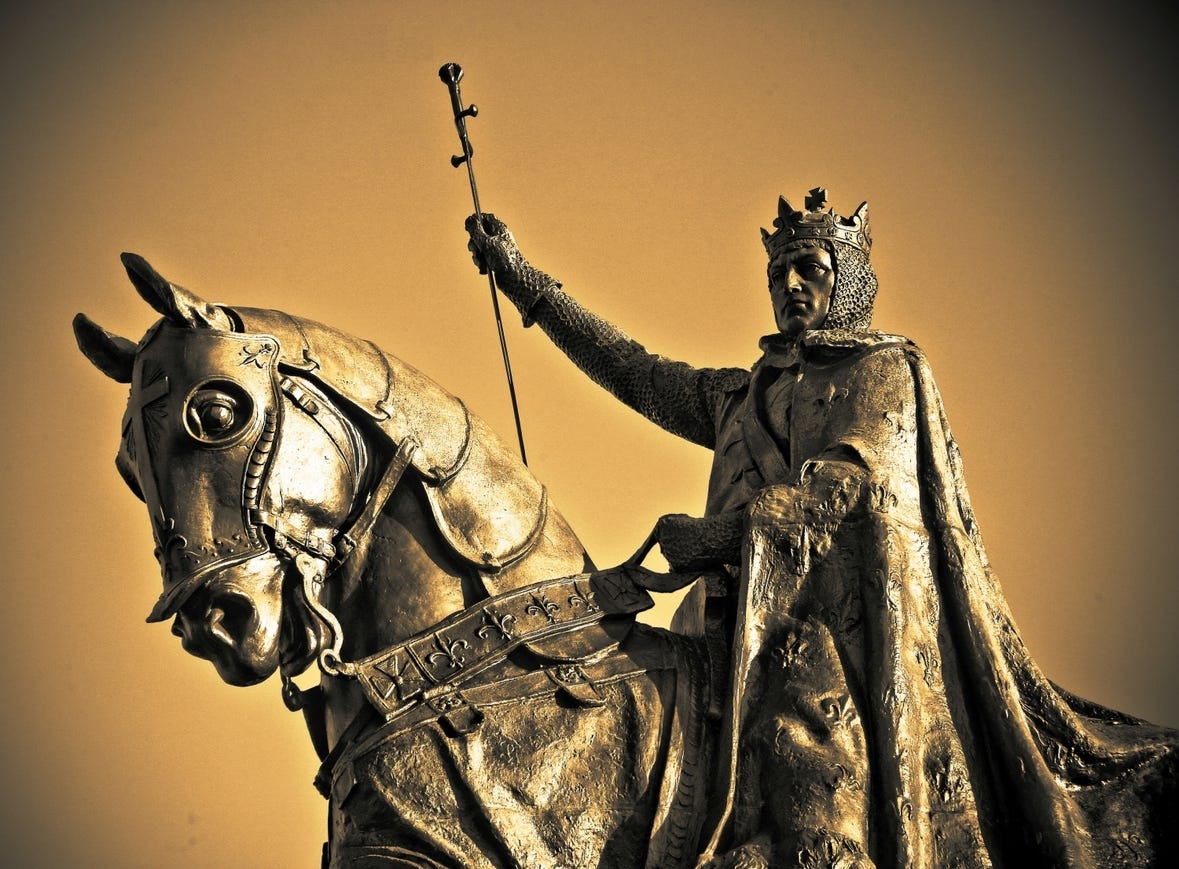
There are warrior-saints like St. George, St. Ignatius, and St. Louis IX, the Crusader king of France.
There are martyr-missionaries like St. Isaac Jogues and the other North American Martyrs (René Goupil, Jean Lalande, Jean de Brébeuf, Antoine Daniel, Gabriel Lalemant, Charles Garnier, and Noël Chabanel), as well as all the thousands of other men who’ve willingly given their lives for the name of Christ.
There are also intellectual warriors, like St. Thomas Aquinas who almost singlehandedly established scholastic theology and whose texts and arguments keep defeating heretical arguments until today.


This article is too short and general to do an in-depth biography of each of the thousands of Saints and Martyrs upon which the Catholic Church was built, but I highly recommend you study these men, whose stories are not only inspirational, but deeply practical: each one of them is an example of masculine virtue in a different calling, at a different time, and with a different focus. Their stories can guide you forward, towards real Christian masculinity and a sincere imitation of Christ.
Beyond the specific stories of these great men, another pillar of tradition within our faith is that of monastic masculinity, where we can see thousands of men deciding to remove themselves from the world entirely to dedicate their lives to the spiritual disciplines that matter most.
There’s the Benedictines, with their motto Ora et Labora (pray and work), who tamed the wilderness, built monasteries, and brought civilization to Europe with a combination of hard physical labor, intellectual work, and spiritual discipline.
There’s the Franciscans, whose vocation for evangelical poverty serves as a form of spiritual warfare and allows them to engage in dangerous missionary work.
There’s also the Dominicans, who’ve made it their mission to engage in intellectual combat against heresy, established universities and schools, and played a massive part in furthering theology and other fields of study.
There’s Jesuits, Carmelites, Trappists, and many, many other orders, all sharing one faith, one commitment to the Truth of Christ, and one incredibly masculine willingness to lose their lies to spread the Gospel and keep building the Holy Church Jesus left us two thousand years ago.


Catholic Principles of Masculine Virtue
Studying these Catholic masculine exemplars allows us to extrapolate a clear pattern of integrated virtue that contrasts heavily with the fragmented masculinity that modern culture proposes:
Sacrificial responsibility. True masculinity mirrors Christ’s self-offering, and strength reveals itself through laying down one’s life for others —or through being willing to do so.
Protective strength: Not as “controlling behavior”, like modern feminist theory might claim, but as the sacred duty to defend God, Church and family against spiritual and physical threats.
Lives driven by mission: Feeding the masculine urge to conquer territory, but not for selfish or sinful reasons, but for Christ and His kingdom, mostly through evangelization and cultural transformation.
Righteous confrontation: Understanding that defending truth against error requires the courage to speak difficult truths, call a spade a spade, and stand behind your words, even when it costs everything.
One of the most important distinctions between all the great men of faith in history from the modern emasculated male is a firm refusal to compromise on their values and the ability to tame and direct the ambition and fire in their souls towards sacrifice and service.
True masculinity combines tender mercy with uncompromising truth, it shows compassion without compromising moral clarity.
Christian masculinity (which is the only real kind of masculinity) shows that strength and gentleness are not opposites but complementary virtues in the complete man. Most importantly, it is characterized by leadership that serves: the most masculine men do not seek to lead for the power that leadership brings, but due to a sincere desire to show others the light of Christ.
This integration is what the evil one and his architects of emasculation fear the most: men who are simultaneously strong and holy, decisive and humble, courageous and compassionate, and who cannot be manipulated because their identity comes from Christ, not from cultural influences.
History Shows the Way
The messages about masculinity are confusing and contradictory nowadays. Some say men should cry more often, some say men should have no feelings at all. Some say men should never do anything for themselves and some say men should only care about themselves. Where can we find clarity?
Thankfully, our spiritual ancestors show us the way, and they are proof that it’s possible —and desirable, and good— to strive to combine those qualities which modern culture calls incompatible: strength and gentleness, courage and humility, mystical prayer and practical action.
These men, beginning with Christ, show us that authentic manhood requires the whole man —body, mind, and soul— to surrender his life to Christ and deploy it in service of His kingdom.
This is the real revolution of masculinity: the striving towards virtue, the refusal to compromise, and the rejection of the temptations of nihilism, laziness, apathy and fear.
The sanctification of the fire that urges us forward.
History shows us the way. But we need more than general, abstracts concepts of masculinity. We are at war, and all wars require strategy.
How do we fight back and win the war for Christian masculinity in our generation?
That’s what we’ll explore in the next installment of this series. You can read the fifth and final article here:

Thank you for reading.
If you enjoyed this post and could leave a like or comment it would be greatly appreciated, as it will help my work reach more people
If you liked this article, you’ll love my books.

Thank you for writing this powerful article. I’ve been saying for years that all anger isn’t wrong, it’s if we sin in our anger that’s unbiblical. Righteous anger has its place, and as you pointed out, Christ showed us that.
There’s been such an intense attack on Christian masculinity in our culture, and I’m passionate about doing my part to push back. I volunteer my time mentoring boys and young men teaching them how to hunt and fish, how to protect and provide, and how to become strong, grounded men who love and defend women.
I tell my community and those that will listen to start small, local in hopes that positive change will have a ripple effect.
"We need to let the full weight of our inadequacy weigh on our shoulders, not so we can cry and moan about how bad the world is, but so we can let it strengthen our backs and our spines, so we can honor our Lord and follow the footsteps of all the warriors of old who fought and died for Him."
Yes. Exactly.